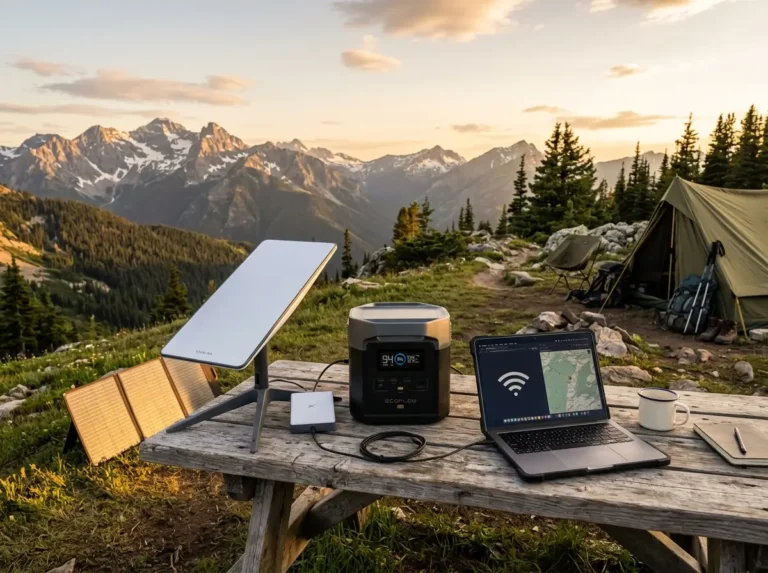
The Starlink Mini is a game-changer for digital nomads, campers, and off-grid enthusiasts. It offers high-speed satellite internet in a compact package that fits inside a backpack. However, because it is designed for portability, managing its energy usage is crucial.
To maintain a reliable connection in remote areas, you need a high-quality portable power station. This article breaks down the Starlink Mini power consumption and reviews the 5 best solar generators to keep your remote office running.
Table of Contents
Starlink Mini Power Consumption Explained
The Starlink Mini is significantly more efficient than the standard Starlink Actuated or Flat High Performance models. While older versions often required 50W to 100W, the Mini is optimized for low-power environments.
Power Usage Breakdown
- Idle State: 20W to 25W.
- Active Usage: 25W to 40W (during streaming or large downloads).
- Peak Usage: Up to 60W (during initial boot-up or when the snow-melt heater is active).
Daily Energy Consumption Estimates
- 8 Hours of Usage: Approximately 240Wh.
- 12 Hours of Usage: Approximately 360Wh.
- 24 Hours of Usage: Approximately 720Wh.
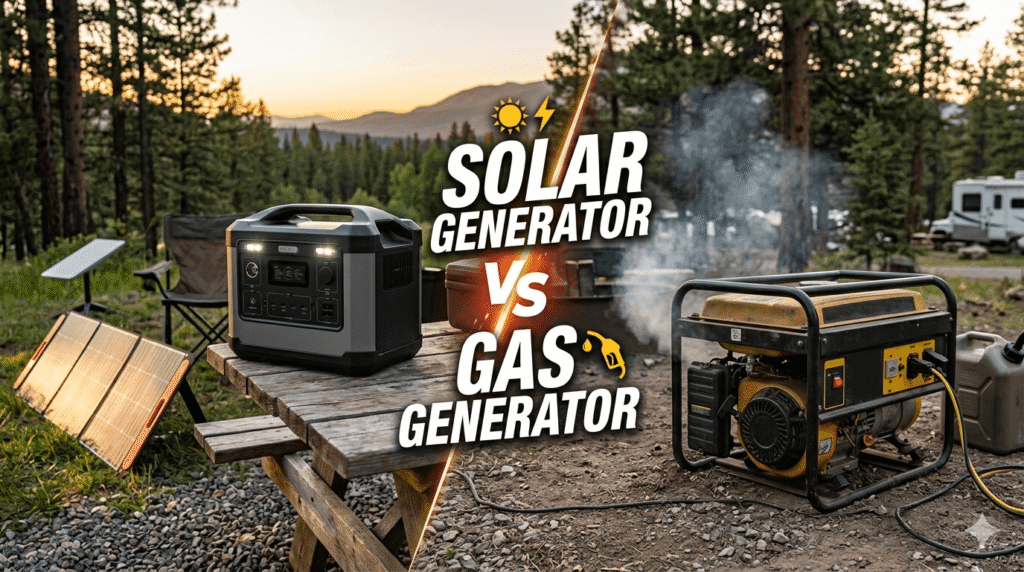
Demand for portable solar solutions is rising fast as more people shift to remote work, van life, and off-grid living. Choosing the right generator ensures you stay connected during critical tasks like video calls or remote work sesions. Some users still consider gas generators as a backup option, especially for long cloudy periods. If you are deciding solar vs gas setups, we compared both approaches in detail, including cost, noise, and long-term usability.
What Solar Panels Do You Need for Starlink Mini?
Running a generator without a solar panel makes no sense long-term. You are just draining the battery.
Like we said – Starlink Mini uses around 240Wh to 720Wh per day depending on usage. That means your recharge source matters more than the battery itself.
A 100W solar panel will barely keep up if you use Starlink for 8 – 10 hours daily.
A 200W portable solar panel is the realistic minimum if you want stable off-grid usage.
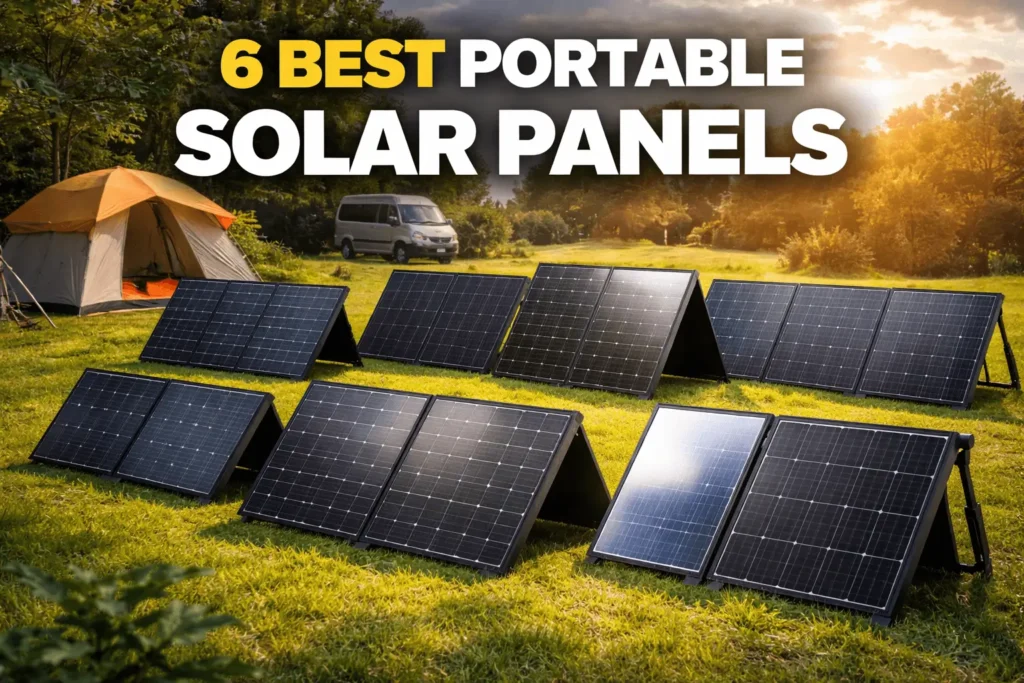
If you are building a full setup and if you are not sure what actually works, we already broke it down in our portable solar panels for camping article.
Comparison Table: Best Solar Generators for Starlink Mini
| Product Name | Capacity | AC Output | Weight (lbs/kg) | Best For | Amazon Price |
|---|---|---|---|---|---|
| Anker SOLIX C1000 Gen 2 | 1024Wh | 2000W | 24.9 lbs / 11.3 kg | Off-Grid Living | Check Price |
| EcoFlow River 3 | 245Wh | 300W | 7.8 lbs / 3.5 kg | Extreme Portability | Check Price |
| BLUETTI Elite 30 V2 | 288Wh | 600W | 9.4 lbs / 4.3 kg | High Efficiency | Check Price |
| Jackery Explorer 300 | 293Wh | 300W | 7.1 lbs / 3.2 kg | Reliability | Check Price |
| EcoFlow RIVER 2 Pro | 768Wh | 800W | 17.2 lbs / 7.8 kg | Balanced Use | Check Price |
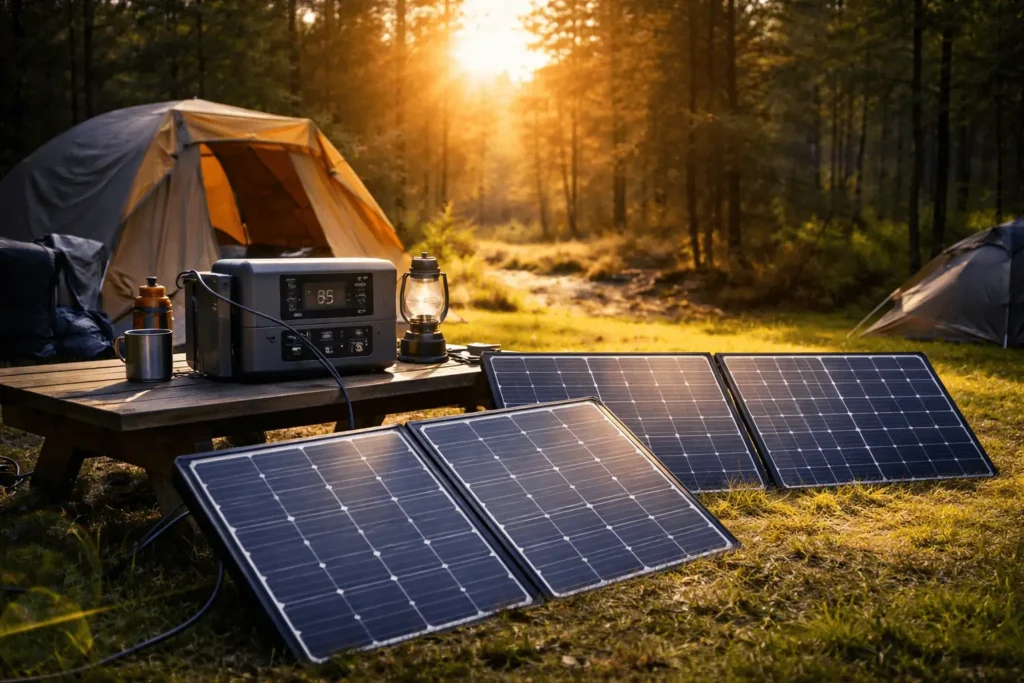
If you want a broader breakdown beyond Starlink-specific use, you can check our full comparison of portable solar generator for camping setups or more specifically solar generator for RV, where we test real-world performance across different scenarios.
1. Anker SOLIX C1000 (Gen 2)
The Anker SOLIX C1000 Gen 2 is the heavy hitter on this list. It is designed for those who live off-grid for days at a time and need to power more than just the internet.
Key Specifications
- Capacity: 1024Wh.
- Weight: 24.9 lbs / 11.3 kg.
- Solar Input: 600W (recharges in 1.8 hours).
- Battery Life: 4,000 cycles to 80 percent capacity.
Why Anker SOLIX C1000 (Gen 2)? – Massive Capacity for Long-Term Connectivity
With its massive capacity, the C1000 can power the Starlink Mini for over 30 hours. It features a 10ms UPS backup, ensuring that if you are connected to a grid that fails, your Starlink won’t even reboot. It is 11 percent lighter than similar models, making the 24.9 lbs / 11.3 kg weight managable for RV storage.
2. EcoFlow River 3
The EcoFlow River 3 is the ultimate companion for the “light and fast” traveler. It uses GaN technology to maximize efficiency for low-wattage devices like the Starlink Mini.
Key Specifications
- Capacity: 245Wh.
- Weight: 7.8 lbs / 3.5 kg.
- Solar Input: 110W (recharges in 2.6 hours).
- Noise Level: Under 30 dB.
Why EcoFlow River 3? – Efficiency with GaN Technology and Ultra-Portability
The River 3 is 30 percent smaller than the industry average. At only 7.8 lbs / 3.5 kg, it can literally fit in a small bag. The X-GaNPower technology is specifically designed to double the runtime for appliances under 100W, making it perfect for the 25W-40W draw of the Starlink Mini.
3. BLUETTI Elite 30 V2
The BLUETTI Elite 30 V2 is a rugged, compact power station. It stands out due to its incredibly fast charging and high efficiency.
Key Specifications
- Capacity: 288Wh.
- Weight: 9.4 lbs / 4.3 kg.
- AC Output: 600W (1500W Power Lifting mode).
- Fast Charge: 0 to 80 percent in 45 minutes.
Why BLUETTI Elite 30 V2? – Low Standby Power for Maximum Off-Grid Runtime
The UltraCell technology in this unit reduces standby power consumption by 50 percent. This is critical for Starlink users because it prevents the generator from wasting energy while the dish is idle. At 9.4 lbs / 4.3 kg, it is easy to move around the campsite.
4. Jackery Explorer 300
Jackery is a household name in the camping world. The Explorer 300 is a classic, reliable choice for those who want a simple, plug-and-play solution.
Key Specifications
- Capacity: 293Wh.
- Weight: 7.1 lbs / 3.2 kg.
- Output: 300W Pure Sine Wave.
- Recharge: 2 hours to 80 percent via wall and USB-C.
Why Jackery Explorer 300? – The Lightest Reliable Power for Weekend Travelers
The Explorer 300 is the lightest on this list at 7.1 lbs / 3.2 kg. It provides clean, stable power that is safe for sensitive electronics. If you are a weekend warrior who only needs internet for a few hours a day, this is the most user-friendly option.
5. EcoFlow RIVER 2 Pro
If you need more than a few hours but don’t want the weight of a 1000Wh unit, the RIVER 2 Pro is the perfect middle ground.
Key Specifications
- Capacity: 768Wh.
- Weight: 17.2 lbs / 7.8 kg.
- Solar Input: 220W (recharges in 3.5 hours).
- Battery Type: LFP (3,000+ cycles).
Why EcoFlow RIVER 2 Pro? – Balanced Performance for Multi-Device Setups
With 768Wh, you get over 20 hours of continuous Starlink usage. It is relatively portable at 17.2 lbs / 7.8 kg and features 11 outlets, allowing you to charge your phone, laptop, and drone while the internet is running.
How Long Can These Generators Power Starlink Mini Power Consumption needs?
To calculate runtime, you must account for the 15 percent energy loss that occurs when the generator converts DC battery power to AC wall power. However, using a USB-C to DC cable or a direct DC output can extend your runtime by approximatelly 20 percent by skipping this conversion process.
Estimated Runtimes (AC Connection)
- 245Wh Battery: 6 to 8 hours.
- 288Wh / 293Wh Battery: 8 to 10 hours.
- 768Wh Battery: 20 to 24 hours.
- 1024Wh Battery: 30+ hours.
To maintain these runtimes daily, your solar input must match your consumption. Without proper solar panels, even the largest generator will run out in a day. So our advice is to compare portable solar panels that can actually recharge these generators.
Pro Tip: Bypass the Inverter
Starlink Mini supports 12V-48V DC input. By using a dedicated DC power cable instead of the standard AC plug, you eliminate energy conversion loss and can gain up to 2-3 extra hours of internet on a single charge. This is the most efficient way to power your Starlink off-grid.
FAQ Section
How many watts does the Starlink Mini use?
The Starlink Mini typically consumes between 20W and 40W during normal operation, with occasional peaks up to 60W during startup.
Can I power Starlink Mini with a solar panel?
Yes, you can connect a solar panel to a solar generator, which then powers the Starlink Mini. A 100W to 200W panel is usually sufficient.
Is the Starlink Mini more efficient than the standard dish?
Yes, the Starlink Mini consumes about 50 percent less power than the standard Gen 2 Actuated dish, making it better for battery use.
What is the best weight for a portable generator?
For hikers, look for units under 10 lbs (4.5 kg). For car campers, units between 15 lbs (6.8 kg) and 25 lbs (11.3 kg) offer better capacity.
Can I use Starlink Mini in the rain?
The Starlink Mini is weather-resistant, but your solar generator should be kept in a dry, ventilated area to avoid damage.
Conclusion
Staying connected in the wild has never been easier. By choosing one of these 5 solar generators, you ensure that your Starlink Mini has the steady, clean power it needs. Whether you prioritize the light weight of the Jackery Explorer 300 (7.1 lbs / 3.2 kg) or the massive capacity of the Anker SOLIX C1000 Gen 2 (24.9 lbs / 11.3 kg), there is a solution for every type of traveler.
And of course last but not least – None of this matters if you cannot recharge your system efficiently. The panels you pair with your setup will decide whether your generator keeps up or fails in real conditions, which is why we broke down the most reliable portable solar panels for camping based on actual output and durability.
If you have any additional questions about solar setups, feel free to contact us.