
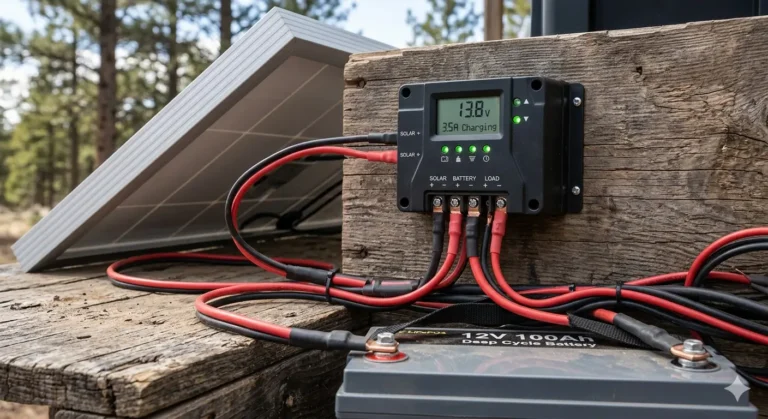
Solar charge controller selection decides how much energy you actually keep from your panels. Pick wrong, and you lose 10 to 30 percent of your power before it even reaches the battery.
You are not choosing between brands first. You are choosing between MPPT and PWM, and that decision controls everything else.
Table of Contents
What a Solar Charge Controller Actually Does
A solar charge controller regulates voltage and current from your panels into your battery.
Without it:
-battery overcharges
-voltage spikes damage electronics
-lifespan drops fast
Although those three points sound simple, they usually happen gradually rather than overnight. Many off-grid users believe their batteries “just got old” after two or three years. In reality, improper charging is often responsible for most of the lost capacity.
This becomes expensive when powering equipment such as portable refrigerators, CPAP machines, Starlink Mini, communication gear, or emergency backup systems. Battery performance directly determines how long those devices continue running after sunset.
A properly sized solar charge controller protects that investment every single day while maximizing the amount of energy collected from your solar panels.
Why a Solar Charge Controller Is the Heart of Every Solar System
Many beginners focus on the solar panel because it produces electricity. Others spend most of their budget on a larger battery bank. In reality, the solar charge controller decides how efficiently those two expensive components work together.
A solar panel does not produce a constant voltage. Output changes throughout the day as sunlight intensity, panel temperature, and shading conditions change. Battery voltage changes as well while charging and discharging. Connecting a solar panel directly to a battery means both components operate without any regulation.
The result is rarely efficient.
Instead of charging the battery using the proper charging stages, the panel simply pushes whatever power it can produce at that moment. During peak sunlight, battery voltage may rise above the safe charging limit. During weak sunlight, charging becomes inconsistent and much less efficient.
A quality solar charge controller constantly measures battery voltage and adjusts charging in real time. Better models also monitor battery temperature, compensate for voltage changes, and switch automatically between charging stages without requiring any user input.
This process becomes even more important with lithium batteries. Unlike flooded lead-acid batteries that tolerate occasional overcharging, modern LiFePO4 batteries require precise voltage control to maintain both performance and long service life.
For an off-grid system that operates every day, the controller quietly becomes one of the most valuable components in the entire installation.
What Happens If You Skip the Solar Charge Controller?
Many people ask whether they can connect a small solar panel directly to a battery.
Technically, yes.
Practically, you should not.
Without a solar charge controller, several problems appear almost immediately.
Overcharging
Once the battery reaches full charge, the panel keeps supplying current whenever sunlight is available. Excess voltage creates heat inside the battery and accelerates chemical degradation.
Deep battery stress
When charging voltage fluctuates throughout the day, batteries spend less time within their ideal operating range. Capacity slowly decreases after repeated charging cycles.
Reduced battery lifespan
A battery designed to last ten years may lose several years of usable life simply because it never receives a proper charging profile.
Unsafe operating conditions
Some battery chemistries release gas during overcharging. Others contain built-in battery management systems that disconnect unexpectedly when voltage limits are exceeded. Both situations interrupt power delivery and may damage connected equipment.
For expensive battery banks, replacing one battery often costs considerably more than buying a quality solar charge controller in the first place.
Types of Solar Charge Controller Systems
You have two real options:
- PWM solar charge controller
- MPPT solar charge controller
They do the same job in very different ways.
PWM Solar Charge Controller Explained
PWM stands for Pulse Width Modulation.
How PWM Technology Actually Controls Charging
Pulse Width Modulation has existed for decades and remains one of the simplest ways to regulate battery charging. The controller rapidly switches the connection between the solar panel and the battery on and off thousands of times per second. By changing how long each pulse stays on, the controller limits the average charging current flowing into the battery.
This sounds complicated, but the hardware is surprisingly simple. Unlike an MPPT controller, a PWM solar charge controller does not convert excess voltage into additional charging current. Instead, it reduces the panel voltage until it closely matches the battery voltage.
For that reason, PWM controllers work best when the solar panel voltage already matches the battery system.
For example:
- 18V solar panel
- 12V battery
- short cable run
In this situation, very little energy is wasted because the panel was designed for a 12V charging system.
The moment panel voltage becomes significantly higher than battery voltage, PWM begins throwing away usable energy.
Understanding the Four Charging Stages
Most modern PWM solar charge controllers use a four-stage charging process. Even inexpensive controllers follow this basic sequence because batteries require different charging behavior as they approach full capacity.
Bulk Charge
The controller delivers as much available current as possible. Battery voltage rises steadily while the battery accepts energy quickly.
This stage typically restores around 70 to 80 percent of battery capacity.
Boost (Absorption) Charge
Charging current begins decreasing while voltage remains controlled.
The battery finishes the remaining capacity without overheating.
Float Charge
Once the battery reaches full charge, the controller reduces charging voltage to a maintenance level.
This prevents unnecessary stress while keeping the battery ready for use.
Equalization
Some lead-acid batteries periodically require a controlled higher voltage charge to balance individual cells.
Lithium batteries should never receive equalization unless specifically supported by the battery manufacturer.
These charging stages happen automatically. The user rarely notices them, but they play a major role in battery lifespan.
It connects the solar panel directly to the battery and reduces voltage to match battery levels.
How PWM Works
- panel voltage gets pulled down to battery voltage
- excess voltage becomes wasted energy
- simple circuitry controls charge stages
If your panel outputs 18V and your battery is 12V, PWM forces that 18V down to 12V.
You lose that extra voltage as heat.
Why Voltage Mismatch Costs More Than Most People Think
Many new solar users assume losing a few volts is not a big deal.
Unfortunately, voltage represents potential energy.
Imagine a portable panel producing:
- 20V
- 8A
That equals:
160 watts
If a PWM controller pulls panel voltage down close to a 12V battery, available charging power immediately drops.
The battery still charges.
It simply charges slower because part of the available panel output never reaches it.
This difference becomes much more noticeable during winter when every watt counts. A shorter daylight window leaves less time for charging, so wasted energy becomes increasingly expensive.
Real Example Using a 200W Portable Solar Panel
Suppose you own a 200W folding solar panel for camping.
Weather conditions are excellent.
Panel temperature remains moderate.
Battery sits around 12.4 volts.
A PWM controller may only deliver approximately 150 to 160 watts into the battery.
An MPPT controller under identical conditions could deliver 185 to 195 watts.
That difference of roughly 30 watts every hour becomes meaningful over an entire day.
After six hours of usable sunlight:
PWM:
- around 930Wh
MPPT:
- around 1140Wh
You gain roughly 210Wh.
That is enough energy to power:
- Starlink Mini for several additional hours
- LED campsite lighting throughout the evening
- laptop charging
- camera batteries
- portable refrigerator for a significant amount of time
For occasional weekend camping, that difference may not matter.
For daily off-grid living, it absolutely does.
Real Efficiency Numbers
- 70 percent to 80 percent efficiency typical
- drops further in cold or partial shading
Factors That Reduce PWM Efficiency
The published efficiency numbers tell only part of the story. Real-world performance depends on several variables that change every day.
Efficiency drops when:
- the battery voltage is much lower than panel voltage
- cable runs become longer
- solar panels operate in cold weather
- panels receive partial shading
- battery temperature changes significantly
- multiple panels are wired together
A PWM solar charge controller cannot recover energy lost under these conditions because it lacks voltage conversion hardware.
This explains why two campers using identical solar panels can see noticeably different charging performance depending on how their systems are wired.
Advantages of a PWM Solar Charge Controller
Despite its limitations, PWM technology still offers several practical benefits.
Advantages include:
- lower purchase price
- simple installation
- fewer electronic components
- reliable long-term operation
- excellent choice for small solar systems
- minimal standby power consumption
- widely available replacement parts
Many RV owners continue using PWM controllers for years without experiencing any problems because their systems remain relatively small.
Choosing PWM is not automatically wrong.
Choosing PWM for the wrong application is where problems begin.
Common PWM Installation Mistakes
Several installation mistakes reduce performance before the controller even begins charging.
The most common include:
Using high-voltage residential solar panels
PWM controllers cannot take advantage of excess panel voltage.
Installing undersized wiring
Thin cables increase voltage drop and waste even more energy.
Ignoring controller amp ratings
A controller operating continuously at its maximum rating runs hotter and often has a shorter lifespan.
Mounting inside poorly ventilated compartments
Heat is the enemy of electronic components.
Even quality controllers reduce output if internal temperatures become excessive.
A simple improvement such as increasing airflow around the controller can noticeably improve long-term reliability.
When PWM Makes Sense
Use PWM solar charge controller if:
- small systems under 200W
- tight budget
- short cable runs
- panel voltage matches battery
Anything beyond that starts hurting performance.
MPPT Solar Charge Controller Explained
MPPT stands for Maximum Power Point Tracking.
What Maximum Power Point Actually Means
Every solar panel has one operating point where it produces the highest possible power. Engineers call this the Maximum Power Point.
That point is not fixed.
It changes continuously depending on:
- sunlight intensity
- panel temperature
- cloud cover
- shading
- battery voltage
A standard 200W solar panel might produce its rated output around 18V and 11A under laboratory conditions.
Move that same panel outdoors and everything changes.
A passing cloud reduces irradiance.
The panel heats up under direct summer sun.
Wind cools the cells.
Battery voltage rises during charging.
Every one of these factors shifts the panel’s optimal operating point.
An MPPT solar charge controller constantly searches for that point, adjusting its internal electronics many times per second to keep the panel operating as close as possible to maximum efficiency.
Instead of forcing the panel to match the battery, it allows the panel to work where it naturally produces the most power.
That difference is what separates MPPT from PWM technology.
Think of MPPT Like an Automatic Transmission
A useful way to understand MPPT is to compare it to a vehicle.
Imagine driving up a mountain.
A manual transmission stuck in fourth gear will eventually struggle because engine speed no longer matches the terrain.
An automatic transmission continuously changes gears to keep the engine operating efficiently.
An MPPT controller works in a similar way.
Instead of changing gears, it adjusts electrical operating points.
Instead of engine RPM, it monitors voltage and current.
Instead of wasting available engine power, it extracts as much energy as possible from the solar panel.
The comparison is not technically perfect, but it explains why MPPT consistently produces better results under changing weather conditions.
It constantly adjusts voltage and current to extract maximum power from the panel.
DC-to-DC Conversion Makes the Difference
Unlike a PWM controller, an MPPT solar charge controller contains a high-efficiency DC-to-DC converter.
This electronic circuit allows voltage and current to change independently.
For example:
Solar panel:
- 36V
- 5A
Available power:
180 watts
Battery charging:
- approximately 14.4V
Rather than forcing the panel down to battery voltage, the controller converts excess voltage into additional charging current.
Output might become approximately:
- 14.4V
- 12A
Some energy disappears as heat because no electrical conversion is perfect.
Even so, modern MPPT controllers commonly achieve 95 to 98 percent conversion efficiency.
Instead of wasting voltage, they transform most of it into usable charging power.
Why MPPT Performs Better During Cold Weather
Cold weather surprises many first-time solar users.
Solar panels actually become more efficient as temperatures decrease.
The catch is that panel voltage rises.
A PWM controller cannot benefit from this additional voltage.
It simply reduces everything back toward battery voltage.
An MPPT controller captures that higher voltage and converts it into extra charging current.
This is one reason many RV owners notice significantly better winter charging after upgrading from PWM to MPPT. Many of today’s best solar generators for RV already include high-efficiency MPPT controllers.
Even when daylight hours become shorter, MPPT helps recover more energy from every available hour of sunlight.
Partial Shading Performance
Very few camping setups receive perfect sunlight all day.
Trees move.
Vehicles cast shadows.
People reposition portable panels throughout the afternoon.
Partial shading causes rapid fluctuations in panel voltage.
An MPPT controller responds almost immediately by locating the panel’s new operating point.
Charging continues, although at reduced output.
PWM controllers cannot adapt in the same way.
As panel voltage falls, charging efficiency drops with it.
This difference explains why MPPT often produces noticeably more usable energy in forests, mountain campsites and wooded RV parks.
How MPPT Works
- converts excess voltage into usable current
- tracks optimal power point in real time
- adapts to sunlight and temperature changes
If your panel outputs 18V, MPPT converts that extra voltage into more amps instead of wasting it.
Real Efficiency Numbers
- 90 percent to 98 percent efficiency
- performs better in cold weather
- handles shading better
This is why MPPT dominates larger systems.
Why Laboratory Efficiency Numbers Can Be Misleading
Manufacturers often advertise efficiency figures measured under Standard Test Conditions.
Those conditions include:
- perfect sunlight
- ideal panel temperature
- no dust
- no shading
- correctly sized wiring
Real systems almost never operate under those conditions.
An MPPT controller rated at 98 percent efficiency may spend much of the day operating closer to 95 percent.
That is still excellent.
More importantly, it remains efficient while weather conditions continue changing.
This consistency matters much more than chasing the highest advertised number.
Long Cable Runs Favor MPPT
Cable length affects every solar installation.
Current flowing through electrical wire creates resistance.
Resistance creates voltage loss.
One way to reduce that loss is to transmit power at higher voltage.
MPPT controllers make this possible.
Instead of running low-voltage panels over long distances, installers can use higher-voltage panel configurations.
The controller then converts that higher voltage near the battery bank.
Benefits include:
- smaller cable losses
- improved charging efficiency
- reduced cable size requirements
- greater installation flexibility
This becomes especially valuable for cabins where panels may sit 50 to 100 feet away from the battery bank.
Is MPPT Always Worth the Extra Cost?
Not necessarily.
Many people immediately assume the most expensive controller is automatically the correct choice.
That is not always true.
A small 100W portable panel charging a battery during occasional weekend camping may never recover the additional cost of an MPPT controller.
The opposite is true for systems used every day.
Consider a van equipped with:
- 400W of solar
- lithium batteries
- portable refrigerator
- Starlink Mini
- laptop charging
- lighting
- water pump
In this case, recovering an additional 15 to 25 percent of available solar energy every day quickly offsets the higher purchase price.
The larger the solar system becomes, the easier it is to justify investing in MPPT technology.
Why Professionals Usually Recommend Victron for MPPT Systems
There are many MPPT controllers available online.
Some perform well.
Others simply advertise impressive specifications.
Victron has earned its reputation because its controllers consistently deliver accurate charging profiles, reliable thermal management and excellent monitoring software.
The built-in Bluetooth connection allows users to review:
- daily energy harvest
- historical charging performance
- battery voltage trends
- error history
- firmware updates
This level of visibility makes troubleshooting much easier compared with entry-level controllers that only display basic LEDs.
For users building an off-grid system expected to last many years, reliable monitoring becomes almost as valuable as charging efficiency itself.
MPPT vs PWM Solar Charge Controller Efficiency
Here is the difference in real numbers:
- PWM: 70 to 80 percent
- MPPT: 90 to 98 percent
On a 200W system:
- PWM delivers around 140W to 160W
- MPPT delivers around 180W to 196W
That gap increases as system size grows.
Voltage Advantage of MPPT Solar Charge Controller
MPPT lets you run higher voltage panels.
Example:
- 24V or 36V panels into 12V battery
PWM cannot do this efficiently.
Higher voltage means:
- less cable loss
- longer cable runs
- better performance in low light
This matters in van life and off-grid setups.
Best Solar Charge Controller Options for 2026
Now let’s get into actual models worth using.
Comparison Table
| Model | Type | Amps | Voltage | Battery Support | Key Feature | View in Amazon |
|---|---|---|---|---|---|---|
| Renogy Wanderer Li 30A | PWM | 30A | 12V | Lithium, AGM, Gel | 4-stage charging | Check the price |
| Victron SmartSolar 75/15 | MPPT | 15A | 12/24V | All types | Bluetooth monitoring | Check the price |
| Victron SmartSolar 100/50 | MPPT | 50A | 12/24V | All types | High capacity systems | Check the price |
| Renogy Wanderer 10A | PWM | 10A | 12/24V | Lithium, AGM, Gel | LCD display | Check the price |
| Depvko 30A Controller | PWM | 30A | 12/24V | Lead-acid only | Budget option | Check the price |
Renogy Wanderer Li 30A PWM Solar Charge Controller
This is a classic entry-level solar charge controller
Key points:
- 30A capacity
- supports lithium and lead-acid
- 4-stage charging
Bulk charging handles about 80 percent of battery fill fast. Then boost and float stages stabilize voltage.
You get:
- overcharge protection
- short circuit protection
- temperature compensation
Compact design makes it fit RV cabinets easily.
Real use case:
- small RV setup
- 100W to 200W panels
Anything bigger ,efficiency loss starts to show.
Best For
The Renogy Wanderer Li 30A is an excellent choice for beginners building a reliable 12V off-grid system without spending premium money on MPPT technology. It works particularly well for RV owners, weekend campers, small cabins, fishing boats, and portable solar setups using up to approximately 400W of solar panels.
If your system mainly charges a single battery bank during camping trips or occasional off-grid use, this controller delivers everything most users actually need.
Real-World Performance
In real-world camping conditions, the Wanderer Li performs consistently with properly matched 12V solar panels. The four-stage charging profile helps maintain battery health while protecting against common electrical faults such as reverse polarity and overcharging.
The optional BT-1 Bluetooth module also adds remote monitoring through Renogy’s DC Home app. While Bluetooth costs extra, it gives users access to charging voltage, solar input, battery status, and historical charging information without opening electrical compartments.
For lithium battery owners, dedicated charging profiles simplify installation compared with many generic PWM controllers that require manual voltage adjustments.
What We Like
- Supports LiFePO4, AGM, Gel and Flooded batteries
- Reliable four-stage charging
- Temperature compensation support
- Compact housing for RVs and vans
- Expandable with Bluetooth monitoring
- Strong reputation for long-term reliability
Things to Consider
The Wanderer Li remains a PWM controller.
If you’re using higher-voltage solar panels or planning to install more than about 300 to 400 watts of solar, an MPPT controller will recover noticeably more energy throughout the day.
Recommended Setup
The Renogy Wanderer Li 30A pairs well with:
- 100W to 300W portable solar panels
- 100Ah to 200Ah LiFePO4 batteries
- Weekend camping
- Small camper trailers
- Fishing boats
- Backup power systems
Victron SmartSolar MPPT 75/15 Solar Charge Controller
This is where MPPT starts making sense.
Specs:
- 15A output
- 75V max PV input
- Bluetooth built-in
It tracks power point aggressively.
Even with partial shade , it adjusts and keeps output stable.
You can monitor everything through the app:
- voltage
- current
- battery state
This level of control changes how you manage your system.
Best For
The Victron SmartSolar 75/15 is designed for users who want premium charging performance from a relatively compact solar installation. It is one of the most popular MPPT controllers among van builders, overlanders, sailboat owners, and serious campers because it combines excellent efficiency with advanced monitoring features.
Although its initial cost is higher than many PWM alternatives, the additional energy harvested every day often justifies the investment.
Real-World Performance
One of the biggest advantages of this controller appears during less-than-perfect weather.
Instead of losing significant output when clouds pass overhead or temperatures fluctuate, the SmartSolar controller continuously tracks the panel’s optimum operating point.
This allows it to recover additional charging power that PWM controllers simply leave unused.
Bluetooth connectivity is built directly into the controller.
Using the VictronConnect app, users can review:
- Daily solar production
- Historical charging graphs
- Battery voltage
- Charging stage
- Error history
- Firmware updates
For many users, this visibility alone makes troubleshooting dramatically easier.
What We Like
- Excellent MPPT efficiency
- Built-in Bluetooth
- Outstanding mobile application
- Reliable firmware updates
- Very low standby power consumption
- Exceptional long-term reliability
Things to Consider
The 15A output limits future expansion.
If you expect your solar array to exceed roughly 220W to 250W, moving directly to the larger 100/50 model often makes more financial sense.
Recommended Setup
Ideal for:
- Starlink Mini (If you’re planning to power satellite internet in remote locations, read our guide on How Long Will a Solar Generator Run Starlink Mini to calculate runtime and choose the right battery capacity.)
- Portable refrigerators
- Laptop charging
- Weekend van life
- Portable 200W solar panels (Pairing the controller with an efficient portable panel makes a noticeable difference. Our guide to the Best Portable Solar Panels for Camping and Off-Grid Use compares real-world performance, charging speed, and portability.)
- LiFePO4 battery systems
Victron SmartSolar MPPT 100/50 Solar Charge Controller
This one targets serious setups.
Specs:
- 50A output
- 100V input
- scalable systems
You can connect multiple controllers in sync.
That matters if you expand later.
This unit handles:
- van life builds
- off-grid cabins
- high watt solar arrays
Performance difference vs PWM becomes obvious here.
Best For
If you’re building a serious off-grid electrical system, this is where MPPT technology really begins to shine.
The SmartSolar 100/50 comfortably supports much larger solar arrays while maintaining the same advanced charging algorithms and Bluetooth monitoring found in Victron’s smaller models.
This controller is frequently used in full-time van conversions, cabins, expedition vehicles, and marine installations where daily energy production matters.
Real-World Performance
The larger amp capacity allows significantly more solar input without forcing the controller to operate near its limits.
This becomes valuable during summer when solar panels regularly reach peak production for several hours each day.
Instead of clipping available power, the controller continues converting nearly all available solar energy into usable battery charging current.
Users planning future upgrades also benefit from the additional headroom.
Adding another solar panel later often requires no controller replacement.
What We Like
- Premium MPPT efficiency
- Built-in Bluetooth
- Excellent cooling design
- Large expansion potential
- Professional-grade reliability
- Outstanding software ecosystem
Things to Consider
For very small camping systems, this controller may simply be more than you need.
Its capabilities become worthwhile once solar arrays reach roughly 300W or more.
Recommended Setup
Perfect for:
- 300W to 700W solar arrays
- Full-time van life
- Off-grid cabins
- Starlink Mini
- Portable freezers
- Large LiFePO4 battery banks
- Daily off-grid living
Renogy Wanderer 10A PWM Solar Charge Controller
Small, cheap, functional.
- 10A capacity
- LCD display
- basic load control
Works for:
- 50W to 100W panels
- simple lighting systems
Low self-consumption under 10mA helps preserve battery.
Still, same limitation applies:
voltage mismatch wastes energy.
Best For
The Renogy Wanderer 10A is built for compact solar systems where simplicity, reliability, and affordability matter more than maximum charging efficiency. It’s an excellent option for small camper vans, fishing boats, DIY battery boxes, emergency backup systems, and portable power setups using a single solar panel.
If your solar array stays below 100W to 150W, this controller offers enough capacity while keeping installation straightforward.
Real-World Performance
For smaller systems, the Wanderer 10A performs exactly as expected. Charging remains stable throughout the day, and the integrated LCD display provides useful information without requiring a smartphone or additional accessories.
The controller’s extremely low self-consumption means it wastes very little battery power overnight, which becomes especially valuable for systems left connected for long periods.
The built-in USB output also gives campers a convenient way to charge phones, GPS devices, rechargeable flashlights, or small electronics directly from the controller.
What We Like
- Very affordable
- Compact design
- LCD display included
- USB charging port
- Supports multiple battery types
- Excellent for DIY solar projects
Things to Consider
The 10A rating limits future expansion.
If you already know you’ll upgrade beyond one small solar panel, buying the 30A version or an entry-level MPPT controller usually makes more sense.
Recommended Setup
Ideal for:
- 50W to 100W solar panels
- Small camper trailers
- Battery boxes
- Emergency backup kits
- Fishing boats
- Garden sheds
- Weekend camping
Depvko 30A PWM Solar Charge Controller
Budget option. No advanced features.
- 30A rating
- dual USB ports
- LCD display
Limitations:
- lead-acid only
- no lithium support
- lower build quality
Use only if:
- minimal budget
- non-critical system
Best For
The Depvko 30A controller targets buyers looking for the lowest possible entry price. It includes features normally found on more expensive controllers, including an LCD display, dual USB ports, timer functions, and automatic 12V/24V detection.
For hobby projects or light-duty solar installations, it offers good value considering its price.
Real-World Performance
Although the specifications appear impressive, buyers should understand where budget controllers typically compromise.
The controller handles basic charging tasks well when paired with lead-acid batteries and relatively small solar arrays.
However, long-term durability, charging accuracy, and component quality generally cannot match established manufacturers such as Renogy or Victron.
For occasional use, this difference may never become noticeable.
For systems operating every day, investing in a better controller often pays for itself through improved reliability and battery protection.
What We Like
- Very low purchase price
- LCD display
- Dual USB charging ports
- Automatic voltage detection
- Easy installation
- Suitable for basic DIY projects
Things to Consider
This controller does not support lithium batteries.
That alone eliminates it as an option for many modern off-grid systems.
Documentation is also fairly basic, and long-term customer support cannot compete with premium brands.
Recommended Setup
Suitable for:
- Small lead-acid battery systems
- Garden lighting
- DIY solar projects
- Educational use
- Small sheds
- Temporary installations
Not recommended for:
- LiFePO4 batteries
- Daily off-grid living
- Large RV systems
- High-value battery banks
Which Solar Charge Controller Offers the Best Value?
Choosing the best solar charge controller depends less on the controller itself and more on the type of system you’re building. Spending more does not automatically produce better results, but choosing a controller that matches your solar array and battery bank almost always does.
For buyers focused on maximum value, these recommendations provide a good starting point.
Best Budget Choice
Depvko 30A PWM
A practical option for small lead-acid systems where keeping costs low is the highest priority.
Best Beginner Controller
Renogy Wanderer 10A
Easy to install, reliable, and backed by one of the best-known brands in the portable solar market.
Best PWM Controller Overall
Renogy Wanderer Li 30A
Offers excellent battery compatibility, dependable charging performance, and room for moderate system expansion.
Best MPPT for Portable Solar
Victron SmartSolar 75/15
A premium solution for portable solar panels, Starlink Mini users, and weekend off-grid adventures.
Best Overall Solar Charge Controller
Victron SmartSolar 100/50
If you’re building a long-term off-grid power system, this controller provides the best combination of efficiency, monitoring features, expandability, and reliability.
Solar Charge Controller Sizing Basics
Do not guess here.
Use this formula:
Panel Watts ÷ Battery Voltage = Current
Example:
- 200W panel
- 12V battery
→ 200 ÷ 12 = 16.6A
Add 25 percent safety margin:
→ 20A controller minimum
Always oversize slightly.
Common Solar Charge Controller Mistakes
Undersizing
Controller overheats or limits output.
Ignoring Voltage Limits
Panels exceed controller input rating.
This damages the unit.
Choosing PWM for Large Systems
You lose too much energy.
Cost savings disappear quickly.
When PWM Solar Charge Controller Still Makes Sense
Not everything needs MPPT.
PWM works fine if:
- system under 150W
- panels match battery voltage
- short-term or temporary setup
It is simple and reliable.
When MPPT Solar Charge Controller Is Worth It
Use MPPT if:
- system above 200W
- long cable runs
- mixed weather conditions
- need maximum efficiency
This is where it pays for itself.
Real-World Setup Scenarios With Solar Charge Controller
Most people read specs and assume perfect conditions. That’s not how systems behave outside.
Scenario 1: Camping Setup With 100W Panel
- 100W panel
- 12V battery
- short cable run
Using PWM solar charge controller:
- real output around 70W to 80W
Using MPPT solar charge controller:
- real output around 85W to 95W
Difference looks small. Over a full day, that’s 50Wh to 100Wh lost.
That’s a phone, lights, or extra runtime gone.
Scenario 2: Van Life With 300W Solar
- 3 × 100W panels
- 12V battery system
- longer cable runs
PWM result:
- voltage drop increases
- efficientcy drops under 70 percent
MPPT result:
- stable voltage conversion
- better low-light performance
Here the difference becomes huge. You can lose 100W+ daily with PWM.
Scenario 3: Off-Grid Cabin With 600W System
At this scale, PWM makes no sense.
- MPPT pulls maximum power
- handles higher voltage arrays
- reduces cable losses
You gain:
- faster charging
- stable battery health
- predictable output
Solar Charge Controller and Battery Type Compatibility
Not all controllers handle all batteries equally.
Lithium Batteries
Require precise charging:
- stable voltage
- no overcharge
- temperature management
MPPT solar charge controller handles this better.
Some PWM units support lithium, but control is basic.
AGM and Gel Batteries
Both controller types work.
PWM is acceptable for:
- small setups
- low daily usage
MPPT improves efficiency but not critical unless system grows.
Flooded Lead-Acid
Both types work.
PWM often used due to lower cost.
Still, MPPT extends lifespan through better charge control.
Temperature Impact on Solar Charge Controller Performance
Temperature changes output significantly.
Cold Conditions
- panels produce higher voltage
- MPPT captures extra energy
- PWM wastes it
Hot Conditions
- panel voltage drops
- MPPT adjusts dynamically
- PWM loses efficiency
This is why MPPT consistently outperforms across seasons.
Cable Loss and Why It Matters
Long cable runs kill performance.
PWM suffers more because:
- it cannot compensate voltage loss
MPPT helps by:
- allowing higher voltage input
- reducing current in cables
Less current means:
- less heat
- less loss
This becomes critical in RV and van builds.
Monitoring and Smart Features in Solar Charge Controller
Basic PWM units:
- LED indicators
- limited data
Advanced MPPT units:
- Bluetooth monitoring
- real-time data
- historical performance
With Victron controllers, you see:
- daily energy production
- voltage trends
- system errors
This lets you optimize your setup instead of guessing.
How to Choose the Right Solar Charge Controller
Choosing the right solar charge controller starts with understanding your entire solar system rather than simply comparing controller specifications. Many first-time buyers focus only on the amp rating, but panel wattage, battery chemistry, future expansion plans, and daily energy consumption all matter.
A controller that works perfectly with a small weekend camping setup may become a limitation only a few months later after adding another solar panel or upgrading to a larger battery bank.
Before buying, answer these questions:
- How many watts of solar panels will you use today?
- Do you plan to add more panels later?
- Are you using AGM, Gel, Flooded, or LiFePO4 batteries?
- Will the system run only on weekends or every day?
- Do you need Bluetooth monitoring?
- How far are the solar panels from the battery bank?
Those answers usually determine whether a budget PWM controller is sufficient or whether investing in MPPT makes financial sense.
Your charge controller is only one part of the system. Choosing the right battery and power station matters just as much. See our comparison of the Best Portable Solar Generator for Camping before building a complete setup.
Match the Controller to Your Solar Array
The controller must safely handle the maximum current your solar array can produce.
For example:
| Solar Panel Size | Recommended Controller |
|---|---|
| 50W to 100W | 10A PWM |
| 100W to 200W | 20A to 30A PWM or 15A MPPT |
| 200W to 400W | 30A to 40A MPPT |
| 400W to 700W | 50A MPPT |
| 700W+ | High-capacity MPPT system |
Buying a controller with slightly more capacity than your current system leaves room for future expansion without replacing the controller later.
Battery Type Matters More Than Most People Think
Different batteries require different charging voltages.
Lead-acid batteries tolerate charging variations better than lithium batteries, while LiFePO4 batteries require much tighter voltage control.
If you’re building a modern off-grid system with lithium batteries, choose a controller that includes dedicated LiFePO4 charging profiles.
Many premium controllers automatically adjust charging stages depending on battery chemistry, reducing the chance of incorrect charging settings.
Think About Future Upgrades
Many people start with a single 100W portable solar panel.
Six months later they add another panel.
Then a larger battery.
Then a portable refrigerator.
Eventually Starlink Mini.
The original controller suddenly becomes the weakest part of the system.
If you expect your solar setup to grow, spending slightly more on the controller now often costs less than replacing it later.
Use this checklist.
Step 1: Calculate Total Panel Wattage
Add all panel ratings.
Step 2: Identify Battery Voltage
12V, 24V, or higher.
Step 3: Decide Controller Type
- under 150W → PWM
- above 200W → MPPT
Step 4: Add Safety Margin
Increase amperage by 20 to 30 percent.
Step 5: Check Expansion Plans
If you plan to add panels, go MPPT now.
Common Solar Charge Controller Buying Mistakes
Buying the wrong solar charge controller rarely destroys an entire solar system, but it often reduces charging performance, limits future upgrades, and shortens battery life.
These are the mistakes seen most often.
Buying Only by Price
The cheapest controller on Amazon is rarely the cheapest option over several years.
A quality controller protects batteries that may cost several hundred dollars to replace.
Ignoring Battery Compatibility
Some entry-level PWM controllers only support lead-acid batteries.
Connecting a lithium battery without verifying compatibility can lead to incorrect charging behavior.
Always check supported battery chemistries before purchasing.
Choosing the Wrong Amp Rating
A controller operating continuously at its maximum rating runs hotter and leaves no room for future upgrades.
Choose a model with additional capacity whenever possible.
Forgetting Future Expansion
Many off-grid systems grow over time.
Buying a controller sized only for today’s solar panel often means replacing it after adding just one additional panel.
Buying MPPT for a Tiny Solar System
MPPT is excellent technology.
That does not automatically make it the best purchase.
For a single 100W camping panel used a few weekends each year, a quality PWM controller may provide nearly identical real-world results while costing considerably less.
Selecting the correct controller always depends on the entire system rather than marketing claims.
Quick Recommendation Based on Your Setup
If you’re still unsure which controller fits your needs, use this simple guide.
| Your Setup | Recommended Type |
|---|---|
| 100W camping panel | PWM |
| 200W portable panel | MPPT |
| Starlink Mini setup | MPPT |
| Van life | MPPT |
| Cabin | MPPT |
| Emergency backup system | PWM or MPPT depending on panel size |
| 12V AGM battery | PWM works well |
| LiFePO4 battery | MPPT recommended |
| Daily off-grid living | MPPT |
| Weekend camping | PWM is usually enough |
This quick comparison should not replace proper system sizing, but it gives most beginners a reliable starting point before comparing individual models.
Cost vs Efficiency Breakdown
PWM is cheaper upfront.
MPPT costs more but saves energy daily.
Example:
- PWM saves $50 upfront
- loses 20 percent efficiency
Over time:
- lost energy exceeds cost difference
This becomes obvious in daily-use systems.
Solar Charge Controller for Starlink and Off-Grid Internet
This is where efficiency matters more than price.
Starlink setups require:
- stable power
- consistent charging
Using PWM:
- energy loss reduces runtime
- battery drains faster
Using MPPT:
- more usable energy
- longer uptime
If your setup powers internet, do not cut corners here.
FAQ: Solar Charge Controller MPPT vs PWM
What is a solar charge controller and why do you need it?
A solar charge controller regulates voltage and current from panels to battery, preventing overcharge and extending battery life.
Is MPPT better than PWM solar charge controller?
Yes. MPPT solar charge controller delivers up to 30 percent more efficiency in most real conditions.
Can I use PWM solar charge controller with lithium battery?
Yes, but only if the controller supports lithium profiles. MPPT handles lithium more accurately.
What size solar charge controller do I need?
Divide panel wattage by battery voltage, then add 25 percent margin to determine correct amperage.
Do I need MPPT for small solar setups?
Not always. For systems under 150W, PWM solar charge controller works fine if cost matters.