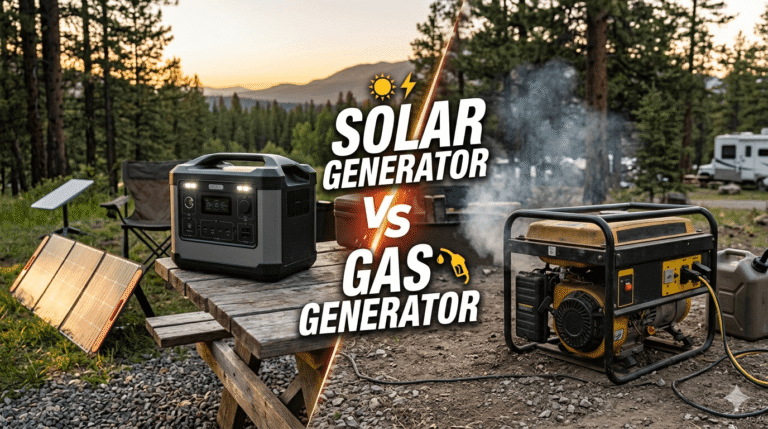
A solar generator vs gas generator comparison starts with one hard fact:
Gas units give instant high output. Solar setups give limited output but infinite fuel.
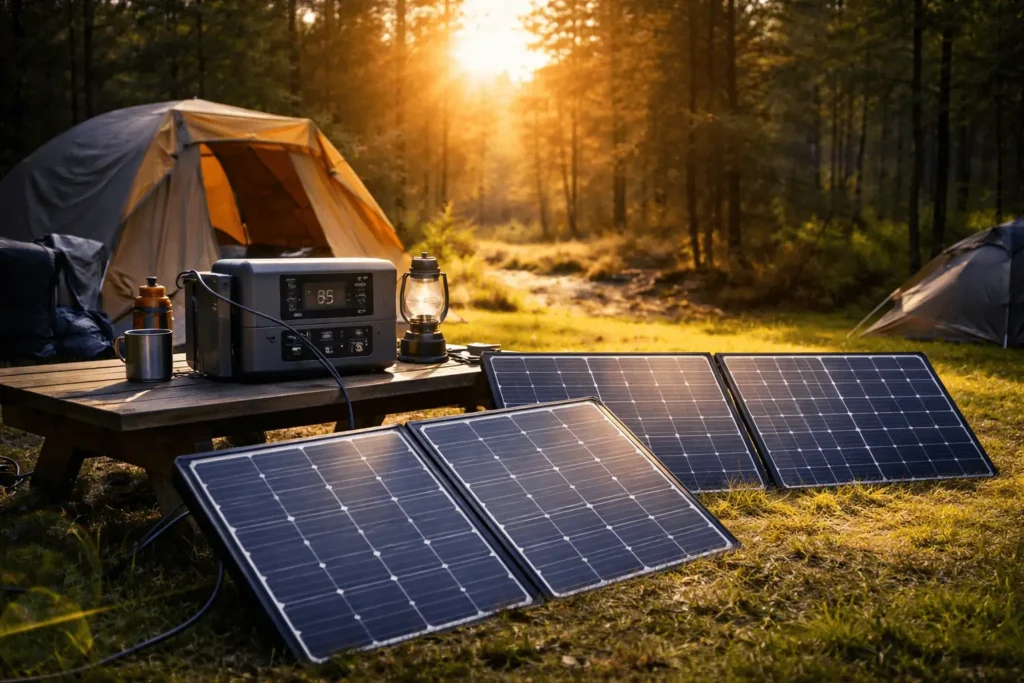
If you are specifically comparing real-world options for off-grid use, it makes more sense to look at actual models instead of just theory in our guide on portable solar generators for camping
If you run a fridge, power tools, or AC, gas wins on raw watts.
If you care about noise, maintenance, and long-term cost, solar starts pulling ahead fast.
No theory. Just numbers and real-world behavior.
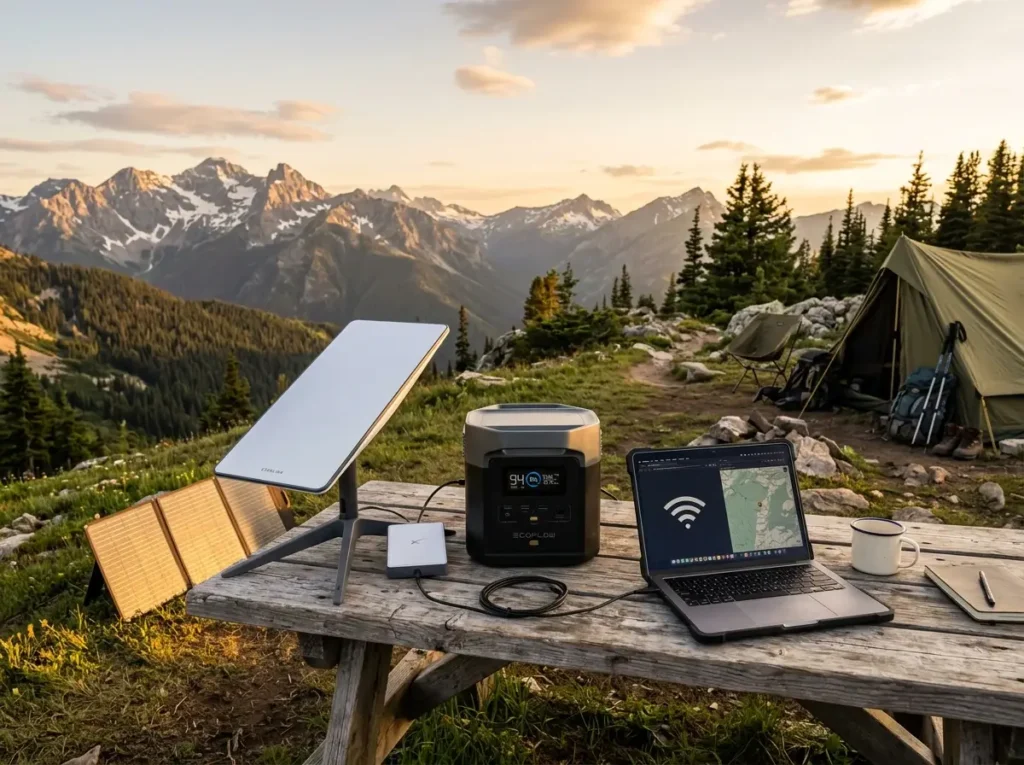
The answer also depends on how you actually use your generator. Someone powering a laptop, Starlink Mini, and LED lights has completely different requirements than someone trying to run an air conditioner or circular saw. Looking only at the advertised wattage often leads buyers to the wrong decision.
Another factor that rarely gets discussed is energy availability. A gas generator stores its energy in fuel, while a solar generator stores it inside a battery that can be replenished every sunny day. That difference completely changes long-term operating costs and the overall ownership experience.
Table of Contents
Solar Generator vs Gas Generator Comparison (Quick Table)
| Feature | Solar Generator | Gas Generator |
|---|---|---|
| Power Source | Sunlight (free) | Gasoline / propane |
| Noise | Silent | Loud (60-80 dB) |
| Maintenance | None | Oil, filters, fuel |
| Runtime | Unlimited (with sun) | Limited by fuel |
| Output Power | 300W – 3000W typical | 2000W – 10000W+ |
| Indoor Use | Safe | Dangerous (CO risk) |
| Startup Time | Instant | Pull start / electric |
| Long-Term Cost | Low | High (fuel adds up) |
At first glance, gas appears to win because of its higher output power. That conclusion changes once you compare ownership over several years instead of only looking at today’s specifications.
Most people buying a portable generator are not running industrial equipment. They want reliable electricity for camping, RV travel, emergency backup, remote work, photography, or outdoor recreation. Those situations reward efficiency, portability, and quiet operation far more than maximum wattage.
If you’ve decided that solar is the better choice, our best solar generator for RV and best portable solar generator for camping guides compares the top models available today.
How Solar Generators Actually Work
A solar generator is just three parts:
- Battery (LiFePO4 in most modern units)
- Inverter (DC to AC)
- Solar input controller (MPPT or PWM)
Panels feed DC power.
Battery stores it.
Inverter turns it into usable AC.
No moving parts. No combustion. No noise.
Typical efficiency chain:
- Panel efficiency: 20% to 25%
- Charge loss: 5% to 10%
- Inverter loss: 10% to 15%
Real usable energy ends up around 70% to 80% of what you generate.
That matters when calculating runtime.
Battery chemistry has improved dramatically over the last few years. Most premium portable solar generators now use LiFePO4 batteries instead of older lithium-ion cells. Besides offering better thermal stability, LiFePO4 batteries typically deliver between 3,000 and 6,000 charge cycles before dropping to around 80% of their original capacity.
Modern MPPT charge controllers also play a major role in overall efficiency. Instead of simply accepting whatever voltage the solar panels produce, an MPPT controller constantly adjusts the electrical operating point to harvest the maximum available energy. Under changing sunlight conditions, this often results in noticeably faster charging compared to simpler PWM systems.
Solar generators depend entirely on charging input. Without proper solar input, even a high-capacity unit turns into a limited battery. That is why solar panel selection matters just as much as the generator itself.
Solar panels also continue improving. Portable folding panels commonly achieve efficiencies above 22%, making today’s compact camping setups far more practical than they were only a few years ago. A quality 200W folding panel can often produce enough daily energy to keep communication devices, laptops, lighting, and portable refrigerators running with careful power management.
How Gas Generators Work (And Why They’re Still Popular)
Gas generators burn fuel to spin an alternator.
That gives:
- High surge power
- Stable output
- Long runtime if you keep refueling
But the downsides hit immediately:
- Noise never goes away
- Fuel degrades over time
- Maintenance is mandatory
Typical efficiency of small gas generators sits around 20% to 30%.
Most of the energy become heat and noise.
Despite their disadvantages, gas generators remain extremely popular because liquid fuel stores an enormous amount of energy in a compact container. Carrying an extra gallon of gasoline provides far more usable energy than carrying another portable battery of similar weight.
That advantage becomes important during extended power outages or construction work where continuous high loads are common. Under those conditions, stopping for a two-minute refuel is often more practical than waiting several hours for batteries to recharge.
Power Output: Where Gas Dominates
This is the main reason gas generators still exist.
A typical camping gas generator:
- 2000W continuous
- 3000W surge
Mid-range models:
- 3500W to 5000W continuous
Solar generators:
- 300W to 2000W common range
- 3000W only in expensive setups
Real implication:
- Cofee maker (800W to 1200W) – both can run it
- Air conditioner (1500W+) – gas handles it easier
- Power tools – gas wins
Solar struggles when multiple devices run at once.
Another advantage is surge capability. Many electric motors require two to three times their normal running power for a brief moment during startup. Gas generators usually handle these temporary spikes without difficulty because the engine continuously produces mechanical power.
Portable solar generators rely on the inverter and battery to deliver surge power. Premium models perform surprisingly well, but prolonged high loads drain batteries rapidly, making sustained heavy-duty operation much less practical.
Battery Capacity vs Fuel Tank
This is where beginners get confused.
Gas:
- 1 gallon = roughly 33 kWh energy equivalent
- Real usable energy after inefficiency = around 7-10 kWh
Solar generator:
- 1000Wh battery = 1 kWh usable (minus losses)
That means:
A small gas generator with a full tank can outlast a solar unit by 5x to 10x in raw energy.
But then comes the catch. Energy storage and energy production are two completely different concepts. A gas generator carries nearly all of its available energy inside the fuel tank. A solar generator stores only the battery capacity but can replace much of that energy every sunny day using portable solar panels.
Over a week-long camping trip, this difference becomes surprisingly significant. While the gas generator gradually empties its fuel tank, a properly sized solar system continues producing fresh energy each morning without requiring another trip to the gas station.
Runtime Reality Check of Solar Generator vs Gas Generator
Gas generator runtime:
- 8 to 12 hours per tank
- Then you refill
Solar generator runtime:
- Limited by battery
- Extended by panels
Example:
- 1000Wh solar generator + 200W panel
- Produces ~800Wh per day in real conditions
That means:
You can run:
- Laptop
- Lights
- Starlink Mini
…indefinitely.
Runtime calculations should always include a safety margin. Battery capacity gradually decreases as batteries age, while cloudy weather reduces daily solar production. Planning for ideal conditions often leads to disappointment during real trips.
For most campers, designing the system around average daily energy consumption instead of maximum battery capacity produces much more reliable results. A generator that comfortably supports your typical usage is far more useful than one that barely survives ideal calculations.
For setups like Starlink Mini, the difference between gas and solar becomes obvious fast. Fuel generators can run longer without planning, but solar setups can sustain indefinitely if sized correctly. We already covered real power usage and runtime scenarios in our Starlink Mini setup breakdown, including what capacity you actually need to stay online.
Gas cannot do that without constant fuel.
Real Fuel Consumption vs Daily Solar Production
Many buyers compare battery capacity with generator wattage, but they rarely compare the actual energy source. This creates unrealistic expectations.
A typical 2,000W inverter gas generator consumes roughly 0.1 to 0.2 gallons of gasoline per hour when powering light loads. Increase the load to 50% or more and fuel consumption rises quickly. During multi-day trips, carrying enough gasoline often becomes a bigger logistical challenge than carrying additional solar panels.
A portable solar generator works differently. Its daily energy budget depends on how much sunlight reaches the panels rather than how much fuel you bring. Under good weather conditions, a 200W portable solar panel can realistically harvest around 700Wh to 1,000Wh per day, while a 400W array can often produce 1.5kWh or more.
For users running modest loads such as:
- Starlink Mini
- laptops
- LED lighting
- camera batteries
- portable refrigerators
daily solar production can replace nearly everything consumed during the previous night. Once the system reaches this balance, fuel stops being part of the equation.
This is the biggest practical difference between a gas generator and a solar generator. One depends on continuous fuel purchases. The other depends on proper system sizing.
Noise: This Changes Everything in Camping
The big winner in this battle of Solar generator VS gas generator about the noise is definitely the solar one.
Gas generators:
- 60 dB minimum
- Often 70-80 dB under load
That is not background noise.
That is:
- Constant engine sound
- Vibration
- Exhaust smell
Solar:
- 0 dB
- No vibration
- No smell
In a campsite or van setup, this alone pushes many people to solar.
Noise also affects the people around you. Many public campgrounds enforce quiet hours during the evening and early morning, making continuous generator operation unpopular or even prohibited. A silent battery-powered setup lets you continue working, charging devices, or watching movies without disturbing neighboring campsites.
For photographers, wildlife enthusiasts, and remote workers, silent operation often becomes one of the biggest reasons to switch from fuel-powered generators to portable solar power.
Maintenance and Failure Points
Gas generator:
You deal with:
- Oil changes every 50-100 hours
- Spark plugs
- Air filters
- Carburetor clogging
- Fuel storage issues
Leave it unused for months and it may not start.
Solar generator:
- No moving parts
- No fluids
- No seasonal issues
You charge it. It works.
Failure rates are significantly lower over time.
Fuel quality becomes another hidden maintenance issue. Gasoline slowly degrades during storage, especially when left inside carburetors for several months. Many generator failures after long storage periods result from stale fuel rather than mechanical defects.
Portable solar generators avoid this entire category of problems. Store the battery at the recommended charge level, recharge it every few months, and it remains ready for use with virtually no ongoing maintenance.
Battery Lifespan vs Engine Lifespan
Modern LiFePO4 batteries have changed the long-term economics of portable power. Many quality solar generators are rated for 3,000 to 6,000 full charge cycles before dropping to around 80% of their original capacity.
For someone who cycles the battery every day, that often translates to 8 to 15 years of practical use.
Gas generators follow a very different maintenance schedule. Engine hours determine reliability. Spark plugs, carburetors, air filters and engine oil eventually become wear items. Even generators that sit unused require attention because gasoline slowly degrades and can clog the fuel system.
If both systems are stored correctly, each can last many years. The difference is how much work is required from the owner to keep them reliable.
Cost Breakdown Over Time
Initial cost:
- Gas generator: cheaper upfront
- Solar generator: higher initial investment
But operating cost flips the equation.
Gas:
- Fuel cost adds up
- Maintenance adds up
Solar:
- Sun is free
- Zero maintenance cost
Example:
- Gas generator running 4 hours daily
- Burns ~0.5 gallons/day
Over 1 year:
- ~180 gallons fuel
- That is serious cost
Solar:
- Same usage – $0 fuel
After 1-2 years, solar often becomes cheaper overall.
Safety: This One Is Not Optional
Gas generators produce carbon monoxide.
You cannot:
- Run them indoors
- Use them in enclosed spaces
- Place them near windows
People die every year from improper use.
Solar generators:
- Safe indoors
- Safe in tents, vans, cabins
- No emissions
This is not a small difference. It is a hard limitation.
Charging Speed: Solar Weakness
Solar generators depend on sunlight.
Reality:
- 100W panel → ~60-70W real output
- 200W panel → ~120-150W real output
Charging a 1000Wh battery:
- 100W panel → 12-15 hours
- 200W panel → 6-8 hours
Gas generator:
- Refill in 2 minutes
That gap matters in bad weather.
Weather Has a Bigger Impact Than Most Buyers Expect
Solar charging figures published by manufacturers usually assume ideal laboratory conditions. Real-world output changes throughout the day.
Several factors reduce charging speed:
- high panel temperature
- haze or thin cloud cover
- poor panel orientation
- dust on the panel surface
- nearby shade
Even partial shading across one section of a panel can reduce production dramatically.
The solution is simple. Reposition the panels every few hours, keep the surface clean, and choose a campsite with full sun exposure whenever possible. Small improvements in placement often recover far more energy than upgrading to a slightly larger battery.
Use Case Breakdown
Camping
Solar wins for:
- Silence
- Lightweight setups
- Phone, laptop, Starlink
Gas wins for:
- Large groups
- High power devices
RV and Van Life
Solar dominates here.
Reasons:
- Daily use
- Noise matters
- Fuel logistics become annoying fast
Gas becomes backup only.
Emergency Backup
Gas:
- Reliable if fuel is available
Solar:
- Reliable if panels are set up
Best setup:
- Hybrid system
Solar for daily use
Gas for emergencies
Off-Grid Living
Solar scales better.
Add:
- More panels
- More batteries
Gas does not scale efficiently. Fuel becomes the bottleneck.
Real Limitation of Solar Generators
People oversimplify solar setups.
Big mistake.
Problems:
- Weather dependency
- Slow charging
- Limited surge power
You need proper sizing.
Example mistake:
- 100W panel + 1000Wh battery
- Expecting full daily recharge
That will fail.
You need:
- 200W+ input minimum
- Preferably 300W-400W for reliability
Where Gas Generators Still Make Sense
You still choose gas when:
- You need high surge power instantly
- You run heavy appliances daily
- You do not care about noise
- You have easy fuel access
Construction sites. Workshops. Large RV setups.
Solar cannot replace gas fully in these cases.
Hybrid Setup: What Actually Works Best
Serious users don’t choose one.
They combine both.
Typical setup:
- Solar generator + panels (daily use)
- Small gas generator (backup)
This solves:
- Cloudy days
- High power spikes
- Emergency situations
You reduce fuel usage by 80%+.
What Most Buyers Get Wrong
They focus only on wattage.
Wrong metric.
You should focus on:
- Daily energy usage (Wh)
- Charging input (W)
- Efficiency losses
Example:
Running 40W device for 10 hours:
- Needs 400Wh
- Add 20% loss –> ~500Wh
That changes your entire setup choice.
Product-Level Comparison: Real Solar Generator vs Gas Generator
You already saw theory. Now actual hardware.
We compare typical solar generator setups (like the ones you already use or reviewed) against equivalent gas generators in the same “use tier”.
Portable Solar Generator vs Gas Generator (Real Specs)
| Type | Model Class | Capacity / Tank | Output | Weight | Runtime |
|---|---|---|---|---|---|
| Solar | 1000Wh class | ~1 kWh | 1500W-2000W | 23-27 lbs | 8-30 hrs (depends on load) |
| Solar | 2000Wh class | ~2 kWh | 2000W-2600W | 35-55 lbs | 15-50 hrs |
| Gas | Small inverter | 1-1.5 gallon | 2000W | 40-50 lbs | 8-10 hrs |
| Gas | Mid-size | 3-5 gallon | 3500W-5000W | 90+ lbs | 10-14 hrs |
Raw numbers look close. They are not.
Solar runtime depends on load and recharge.
Gas runtime depends only on fuel.
Solar Generator Options (Based on Real Units)
1. EcoFlow DELTA 3 Plus (1024Wh, 1800W)
This is a typical “mid-range” portable solar generator for camping.
- 1024Wh LiFePO4 battery
- 1800W output
- 27 lbs
Real usage:
- Laptop + Starlink + lights –> 15-20 hours
- Add solar input (200W- 400W) –> daily recharge possible
What matters here:
- Fast recharge (under 1 hour on AC)
- Good solar input support
- Works as UPS
Where it fails:
- Cannot sustain heavy appliances long
- AC units drain it fast
2. BLUETTI Elite 200 V2 (2073Wh, 2600W)
Now you enter serious territory.
- 2073Wh capacity
- 2600W output
- 53 lbs
Real usage:
- Fridge + Starlink + devices → full-day runtime
- With 400W+ solar → near self-sustaining
Strong point:
- Low standby drain
- High surge capability
Weak point:
- Heavy
- Needs large solar array to keep up
3. Jackery Explorer 1000 v2 (1070Wh, 1500W)
Balanced unit.
- 1070Wh
- 1500W output
- 23.8 lbs
Real usage:
- Weekend camping –> perfect
- Daily off-grid –> needs panels
Strength:
- Lightweight
- Simple setup
Weakness:
- Limited expansion
- Not ideal for heavy loads
4. Anker SOLIX C1000 Gen 2 (1024Wh, 2000W)
Efficient and compact.
- 1024Wh
- 2000W output
- ~25 lbs
Real-world behavior:
- Handles multiple devices without stress
- Strong inverter performance
This is the type of unit you already used in your Starlink setup.
5. Anker SOLIX C300 DC (288Wh, 300W)
Different category.
- 288Wh
- 300W
Use case:
- Ultra-light setups
- Charging phones, laptops
Not a full generator replacement. More like a power bank.
6. BLUETTI AC180 (1152Wh, 1800W)
Reliable mid-tier.
- 1152Wh
- 1800W output
Strong for:
- Mixed usage
- Faster solar charging compared to cheaper units
Gas Generator Benchmarks (Equivalent Tier)
To keep things fair, compare with common inverter generators.
Small Gas Generator (2000W Class)
- 2000W output
- 1 gallon tank
- ~50 lbs
Performance:
- Runs 8 – 10 hours
- Handles most camping appliances
Mid-Size Gas Generator (3500W-5000W)
- High surge power
- Large tank
Performance:
- Runs AC units easily
- Powers entire RV setups
Downside:
- Noise becomes unbearable in quiet environments
Solar Generator vs Gas Generator: Real Use Scenarios
Scenario 1: Starlink + Laptop + Lights
Load:
- 40W Starlink
- 60W laptop
- 20W lights
Total: ~120W
Solar generator:
- 1000Wh → ~8 hours
- With panels → continuous
Gas generator:
- Overkill
- Wastes fuel
Winner: Solar
Scenario 2: Coffee Maker + Fridge
Load:
- 1200W coffee machine
- 100W fridge
Solar:
- Can run it
- Battery drains fast
Gas:
- Handles easily
Winner: Gas
Scenario 3: Full Day Camping Setup
Devices:
- Starlink
- Laptop
- Phones
- Small fridge
Solar:
- Works if you have 200W-400W panels
- Sustainable
Gas:
- Needs refueling
Winner: Solar (long term)
Scenario 4: Emergency Power Outage
Solar:
- Limited by battery
- Recharge depends on sun
Gas:
- Immediate, stable power
Winner: Gas (short term)
Cost Per kWh Comparison
This is where people underestimate solar.
Gas:
- 1 gallon ≈ 7-10 kWh usable
- Fuel cost accumulates
Solar:
- Initial investment
- Near zero cost after
Over 2-3 years:
Solar wins financially in most moderate-use scenarios.
Environmental Impact Beyond Fuel Costs
Fuel expenses are only part of the long-term equation.
Every gallon of gasoline burned releases carbon dioxide, heat and exhaust gases. While occasional emergency use has a limited environmental impact, running a generator every weekend for years creates a measurable footprint.
Solar generators avoid direct emissions entirely during operation. Once the panels and battery are manufactured, producing electricity from sunlight requires no additional fuel.
For campers visiting national parks or remote wilderness areas, this also means preserving the quiet atmosphere that many people travel there to enjoy.
If you plan to use a portable solar generator for camping with a daily recharge cycle, your setup will only work if your solar input keeps up with your consumption. We already broke down real panel performance and what actually works in off-grid conditions in our portable solar panels guide.
For a more detailed breakdown of actual portable solar generator for camping setups tested in real conditions, including runtime and charging speeds, check our full comparison of the best models available right now.
How to Choose Between Solar and Gas (Decision Logic)
Do not overthink it. Use this:
Pick Solar If:
- You camp regularly
- You run low to medium loads
- You care about silence
- You want zero maintenance
Pick Gas If:
- You run high-wattage appliances
- You need guaranteed power anytime
- You don’t care about noise or fuel
Pick Hybrid If:
- You want reliability + efficiency
This is what most serious setups end up using.
Common Buying Mistakes
After comparing dozens of portable power solutions, the same mistakes appear again and again.
Avoid these common problems:
- Buying based only on wattage instead of battery capacity.
- Ignoring charging speed from solar panels.
- Underestimating daily energy consumption.
- Purchasing too few solar panels for the battery size.
- Running everything through the AC inverter when efficient DC outputs are available.
- Forgetting that weather affects solar production every single day.
Planning around daily energy consumption in watt-hours almost always leads to a better purchase than focusing only on maximum output power.
FAQ (Solar Generator vs Gas Generator)
What is better, solar generator or gas generator?
Solar generators are better for quiet, long-term use, while gas generators are better for high power and instant energy.
Can a solar generator replace a gas generator?
Yes for low to medium loads. No for heavy appliances like air conditioners or power tools.
How long do solar generators last?
Most LiFePO4 solar generators last 3000 to 6000 cycles, which equals 8 to 15 years of use.
Are gas generators cheaper than solar?
Upfront yes. Long-term no, because fuel and maintenance increase total cost.
Do solar generators work at night?
Yes, but only on stored battery power. They do not generate energy without sunlight.
End Note
If you are building a real setup, stop thinking in terms of devices.
Think in:
- daily energy usage
- recharge capacity
- system balance
That is what decides whether your setup works or fails.