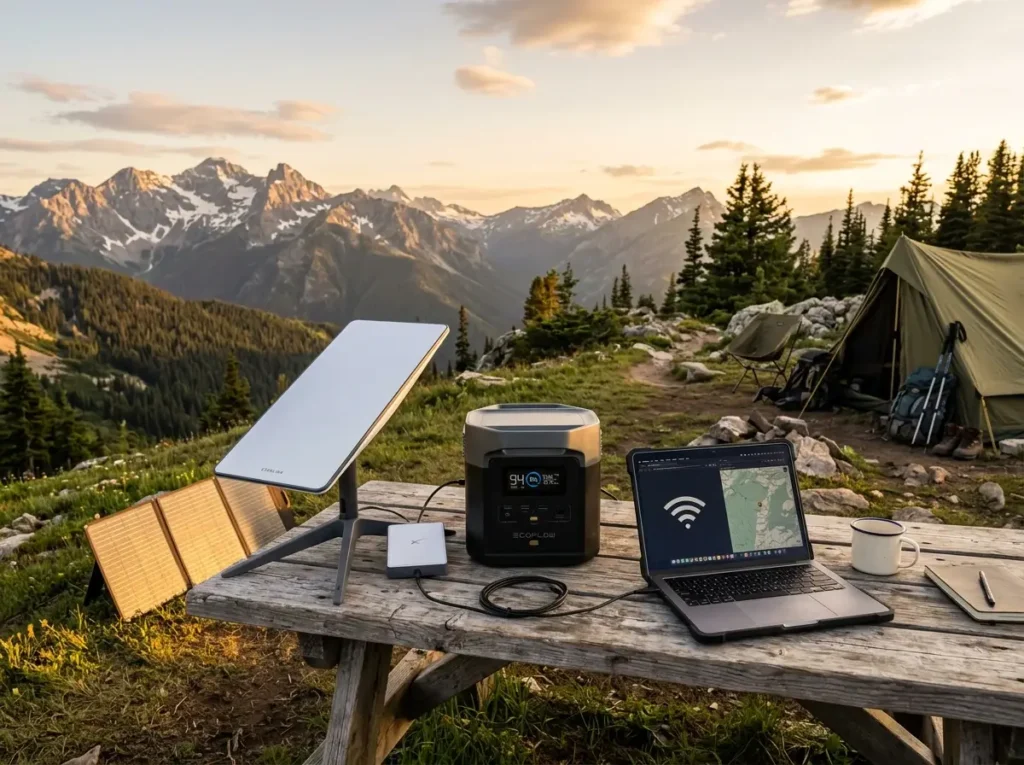
A portable solar generator for camping often fails for one reason.. Between running a Starlink Mini for remote work, keeping a 12V fridge at 38°F, and ensuring CPAP machines stay powered through the night, the demand for off-grid energy has spiked. A standard lead-acid battery wont cut it anymore. You need a portable solar power generator that charges fast, lasts a decade, and doesn’t weigh as much as your cooler.
By 2026, the industry has fully shifted to LiFePO4 (LFP) chemistry. This technology is safer and more durable than older lithium-ion cells. If you buy a generator today, it should handle at least 3,000 to 4000 charge cycles before losing significant capacity. Below is the data-backed breakdown of the six best units currently dominating the market for outdoor enthusiasts.
Table of Contents
Quick Comparison: Best Portable Solar Generator for camping 2026
| Model | Capacity (Wh) | AC Output (W) | Weight (lbs) | Solar Input (W) | Best For | View in Amazon |
|---|---|---|---|---|---|---|
| EcoFlow DELTA 3 Plus | 1024Wh | 1800W | 27 lbs | 1000W | Speed & Versatility | Check the Price |
| Bluetti Elite 200 V2 | 2073Wh | 2600W | 53.4 lbs | 1000W | Heavy Appliances | Check the Price |
| Jackery Explorer 1000 v2 | 1070Wh | 1500W | 23.8 lbs | 400W | Lightweight Utility | Check the Price |
| Anker SOLIX C1000 Gen 2 | 1024Wh | 2000W | 24.9 lbs | 600W | Remote Work/UPS | Check the Price |
| Anker SOLIX C300 DC | 288Wh | 300W (DC) | Ultra-light | 100W | Starlink Mini/Hiking | Check the Price |
| Bluetti AC180 | 1152Wh | 1800W | 37.4 lbs | 500W | Rugged Reliability | Check the Price |
1. EcoFlow DELTA 3 Plus: Best for Fast Charging
The EcoFlow DELTA 3 Plus portable solar generator for camping is the current benchmark for 1kWh portable power stations. It solves the biggest pain point in camping: waiting for the battery to charge. With 1500W AC input, it hits 80% charge in 40 minutes. If you are at a gas station or a trailhead with an outlet, you can get a full day of power in the time it takes to grab lunch.
Technical Performance
The 1024Wh LiFePO4 battery is rated for 4,000 cycles to 80% capacity. This is 25% higher than the previous generation. It features an IP65-rated battery pack, making it splash-proof and dust-proof critical for dusty desert campsites or sudden mountain rain.
- Expansion: You can scale this unit up to 5kWh by adding extra battery packs.
- UPS Mode: Features a 10ms switch-over time. This is fast enough to keep a desktop computer or a NAS server from rebooting during a power flicker.
- Output: X-Boost technology allows it to run resisstive appliances up to 2200W ,meaning it won’t trip the internal breaker when you plug in a hair dryer or an electric kettle.
For those running a mobile office, the app integration provides 12hour storm alerts and customized discharge schedules to save money during peak utility hours.
2. Bluetti Elite 200 V2: Best for Longevity
If your trip involves a large RV, an electric grill, or a coffee maker, the Bluetti Elite 200 V2 is the most powerful portable solar generator for camping on this list. It delivers 2600W of continuous power. With HyperWatt tech, it can “power lift” up to 3900W for specific resistive loads.
Efficiency and Longevity
Bluetti moved to automotive-grade LiFePO4 cells for this model. It boasts 6,000+ cycles, which translates to roughly 17 years of daily use. More importantly, the standby power consumption is only 10W. Most generators lose significant energy just by staying “on,” but the Elite 200 V2 is 3 times more efficient in idle mode.
- Compact Design: It is 40% more compact than its predecessors, making it easier to fit into tight storage bays.
- Fast Solar Charging: Supports up to 1000W of solar input, allowing a full recharge in 2.4 hours under ideal sun.
- Charging Modes: You can toggle between Turbo (fast), Standard (battery-friendly), and Silent (16-30dB) via the app.
This unit is heavy at 53.4 lbs, so it is best suited for vehicle-based camping or as a primary home backup during outages.
3. Jackery Explorer 1000 v2: Best for Lightweight Camping
Jackery perfected the “grab-and-go” design with the Explorer 1000 v2. It weighs only 23.8 lbs—nearly 10 lbs lighter than the EcoFlow Delta 2 and signifficantly lighter than the Bluetti AC180. The foldable handle makes it the most ergonomic unit in the 1kWh class.
User Experience
It delivers 1500W of AC power with a 3000W surge peak. This is more than enough for a full-sized camping fridge and a CPAP machine. Jackery’s ChargeShield 2.0 technology defaults to a 1.7-hour charge to preserve battery health, but you can force a 1-hour emergency charge via the app.
- Quiet Operation: Includes a 30dB quiet overnight charging mode, so the fan noise won’t disturb your sleep in a small tent.
- Simple Interface: Jackery remains the easiest to use for non-technical campers. Plug in and go.
- Durability: The LFP battery stays above 70% capacity after 4,000 cycles.
While it lacks the massive solar input of the EcoFlow, its reliability and weight-to-power ratio make it a top pick for weekend road trips and family camping.
4. Anker SOLIX C1000 Gen 2: The Reliability Expert
Anker built the SOLIX C1000 Gen 2 for durability. The InfiniPower technology uses industrial-grade components and a structural design that handles the vibrations of van life and off-road trails. Reliable power menagement is the most critical factor for long-term off-grid living, and Anker delivers with a 10-year lifespan, making it a top-tier portable solar generator for camping and off-grid work.
Key Specifications
It provides 2000W of output through 10 different ports. The 1024Wh capacity can be recharged in 49 minutes using HyperFlash technology.
- Solar Performance: It accepts 600W of solar (60V max), reaching a full charge in 1.8 hours. This is 20% faster than many competitors in this price bracket.
- Compact Footprint: The Gen 2 is 14% smaller than the original C1000, making it easier to tuck under a camper bed or in a trunk.
- UPS Rating: Like the EcoFlow, it offers a 10ms UPS switchover, making it safe for sensitive medical equipment..
Anker’s app allows for Time-of-Use (TOU) monitoring, which is helpful if you are using the unit at home between camping trips to avoid high electricity costs.
5. Anker SOLIX C300 DC: The Starlink Mini Specialist
The Anker SOLIX C300 DC is a unique portable solar generator for camping that focuses on DC-to-DC efficiency. Most campers do not need a 30-pound brick to charge a laptop or run an LED light. This unit focuses on DC-to-DC efficiency, eliminating the heavy AC inverter found in larger generators. It delivers 300W of power from a compact 288Wh LiFePO4 battery. If your primary goal is to stay online, keep in mind that the Starlink Mini power consumption is low enough that even a small DC station can keeep you running for over 8 hours.
Ultra-Portable Efficiency
Because it skips the AC conversion process, there is less energy loss. You can power a Starlink Mini directly via USB-C, extending your runtime significantly compared to using an AC adapter. It features two 140W bi-directional USB-C ports, allowing you to charge the unit and a high-end laptop simultaneously at full speed.
- Weight and Design: It is 30% smaller than standard 300Wh stations. It includes a shoulder strap attachment for hiking or moving between basecamp and a workstation.
- Charging Options: Recharge to 80% in one hour, using a wall charger or plug in a 100W solar panel for a sustainable off-grid setup.
- Output Ports: Features 7 ports in total, including a 120W car socket, three USB-C ports, and two USB-A ports.
This is the best secondary power station for backpackers or digital nomads who already have a large van setup but need a “day pack” battery for remote work sessions away from the vehicle.
6. Bluetti AC180: The Rugged Workhorse
The Bluetti AC180 portable solar generator for camping sits between the ultra-light Jackery and the massive Elite 200 V2. It is built for environments where gear gets abused. With a 1152Wh capacity and 1800W output, it handles heavy-duty power tools, microwaves, and portable heaters without overheating.
Performance Data
It supports a 1440W AC input, hitting a full charge in roughly 60 minutes. For solar enthusiasts, the 500W DC input is highly efficient, allowing for a 3-hour recharge using 200W to 400W panels.
- Power Lifting Mode: Boosts the output to 2700W for resistive loads like electric frying pans.
- Super Quiet: Operates at a low decibel level, making it one of the stealthiest units for van life or quiet campgrounds.
- Warranty: Comes with a 5-year warranty, which is 2 years longer than most entry-level competitors.
At 37.4 lbs, it requires some muscle to move, but the internal construction is reinforced against drops and vibrations, making it the most reliable choice for off-road 4×4 expeditions.
How to Choose a Portable Solar Power Generator for Camping
For the Weekend Warrior (1-2 Nights)
If you are only charging phones, a camera, and a small fan, the Anker SOLIX C300 DC is sufficient. It takes up minimal space in a trunk and recharges via your car’s 12V outlet on the drive to the site.
For the remote Worker (Starlink Mini Users)
Reliability and UPS features are mandatory. The EcoFlow DELTA 3 Plus or the Anker SOLIX C1000 Gen 2 are the best choices. Their 10ms switchover ensures that if your solar input drops or a cable is pulled, your internet connection won’t drop, saving you from losing unsaved work.
For Full-Time Van Life or RVing
Capacity is king. The Bluetti Elite 200 V2 offers over 2kWh of energy. This is enough to run a 12V fridge for 3 to 4 days without any sun. Its 6,000-cycle lifespan ensures that even with daily discharging, the unit will last well over a decade.
Solar Input Requirements: Don’t Underpower Your Unit
A common mistake is buying a 1000Wh portable solar generator for camping and pairing it with a weak 50W solar panel. You will never finish charging it.
To get the most out of these 1000W inputs, you need to pair them with high-efficiency portable solar panels for camping that match the voltage requirements of your station.
Use this rule for 2026 setups:
- 1kWh Units (Delta 3, Jackery 1000): Use at least 200W of solar panels.
- 2kWh Units (Elite 200 V2): Use at least 400W to 600W of solar panels.
- Check the Voltage: Ensure your panel’s Open Circuit Voltage (Voc) is within the generator’s input range (e.g., 11V-60V).
Campers with larger travel trailers or motorhomes should also see our best solar generator for RV guide for higher-capacity options.
FAQ: Portable Solar Generators for Camping
Can I leave my portable solar generator for camping outside?
Most units have air vents for cooling and are not fully waterproof. While the EcoFlow DELTA 3 Plus has an IP65-rated battery, the main unit should be kept in a ventilated, dry area like a tent vestibule or under a van.
What is the difference between LiFePO4 and Lithium-ion?
LiFePO4 (LFP) is heavier but lasts 3,000 to 6,000 cycles and is chemically stable (it won’t catch fire if punctured). Standard Lithium-ion (NMC) is lighter but only lasts about 500 to 800 cycles before the battery starts to degrade. When choosing a portable solar generator for camping, LiFePO4 is the superior choice for longevity and safety.
Can a portable solar power generator run an AC unit?
Only high-capacity units like the Bluetti Elite 200 V2 or EcoFlow Delta 3 Plus can run small portable or window AC units. A 5,000 BTU AC pulls about 450W-600W. A 1000Wh battery would only power it for about 1.5 to 2 hours.
Do I need a specific brand of portable solar power panel?
No. As long as the connectors match (usually MC4 or XT60) and the voltage is correct, you can mix brands. Check your generator’s manual for the maximum voltage and amperage limits.
Final Safety Checklist
- Grounding: Use the grounding screw on the Bluetti Elite 200 V2 if you are running sensitive medical equipment.
- Ventilation: Never cover the fan ports while the unit is charging or discharging at high wattages.
- Storage: If you aren’t camping, store the battery at 50% to 80% charge. Never store it at 0% for long periods, or you risk killing the LFP cells.